A couple of months ago I saw an advertisement in TimeOut New York magazine that announced the opening of a Civil War Art expo at the Metropolitan Museum of Art. Specifically, the infamous photography of Matthew Brady during the conflict. It had been on my mind for some time to see this exhibit, but with the summer in full swoon there's been much more interest in the beach than checking out some museum, although air conditioning is also a worthy influence. After a tremendous morning at work I decided to hop on the subway for a quick ride to 77th and Lexington and then the few blocks walk to 5th Ave.
The front of the MET (Metropolitan Museum of Art) is undergoing renovations and all these construction walls and eye-sores had me thinking that the main entrance with the large stairs was closed. It turns out when I was exiting that the large stairway entrance is still available, its just that my initial view was blocked off from the annoying construction stuff. I had to enter the museum through a side entrance I never used before. The (recommended) adult donation fee was listed at twenty five bucks, but I just gave them a ten dollar bill. The cashier asked if I wanted any change back, but I let the museum keep the whole ten. The MET used to rely on different colored pins to be worn as proof of paying the entrance fee. A clever individual not interested in making a donation could ask for someone else's pin on the way out, or even better, have every color collected, and just slip on the right one after finding out what color the museum was using that day. Now the museum is no longer relying on the pin color system. Instead they're giving out stickers with the date printed on it to make it more difficult for those clever individuals who might try to sneak in without paying a donation (which literally could be a dollar). It was a weekday afternoon; a perfect time to come when there isn't the usual tourist overload as on weekends. The good part about entering the museum through this way was that I found myself in a section I don't recall ever visiting. I've been to the MET a countless number of times, but I don't remember ever seeing the Ancient Greece section I found myself in. It gave me an opportunity to catch up with Socrates and see a backside that was nearly five thousand years old.
After a little stroll I coincidentally became faced with the Civil War Art exhibit I came to see in the first place. It just popped in front of my face out of nowhere. They placed the section under a large tent, the type of large tents that served as mobile hospitals behind the battlefield to give patrons the an authentic Civil War experience. The only unfortunate part of the exhibit is that it is one of the few areas in which photos are not allowed to be taken. Of course a few tourists found their opportunities to play 'I no read English' and snap a few pictures, which drew the ire of security guards. From what I learned in school and what is generally accepted as common knowledge in American History is that Matthew Brady was mainly responsible for the photographs taken on the battlefields. After reading about the photos - I found out that's not entirely true. Yes, he did spend some time in the trenches with the North and snapped a few pictures when he was able to, but most of the shots came from photographers most people don't know about; Timothy H. O'Sullivan and Alexander Gardner to name a couple. The more cunning Brady was able to collect pictures from these other photographers and publish them in books under his name, taking most of the credit. Brady was initially allowed to accompany Northern troops at the Battle of Bull Run in which the Union foolishly thought the Confederates would be easily defeated by one quick skirmish. The South surprised the North with a victory at Bull Run which gave them the momentum in the war until Gettysburg turned the tide in 1863. The fighting was so fierce at Bull Run that Brady couldn't secure any pictures during the action (with also remembering in those days photography wasn't as simple as it is now). One infamous picture Brady can be rightfully credited for is one of Confederate General Robert E. Lee. The picture was snapped while Lee was in defeat, but he maintained this curiously pleasant look on his face that has brought the image so much notoriety. The photo session took place at Lee's home two days after Lincoln was assassinated. The Lee picture is generally referred to as the last of the Civil War photographs.
The expo contain more than just the photographs, there were actual campaign ribbons from when Lincoln was first running for president. When the war was underway, there were posters trying to get (Caucasian) citizens to enlist. The one I found most interesting was for Field Artillery. They were offering $150 on the spot if you signed up, and $452 if you previously served in the army for more than nine months and wanted to re-enlist. Being part of the Infantry and running up to the front lines with a musket almost guaranteed death, I think I would rather be back with the Field Artillery shooting off cannons, if I had the choice. All the volunteer posters made it clear that if you got drafted, then you would receive no bounty(money). The only way to make money from being a Union soldier is if you volunteered. Blacks did serve in the Union and Confederate armies, but their role was to act as servants for the white soldiers. The film "Glory" tells the true story of an all-Black Union regiment, but those situations were extremely rare. Doctors made use of the camera technology at the time. They would photograph wounded soldiers and show the proper method to amputate a limb or sew up a hole or cut. Then the photographs would be sent to other makeshift hospitals on the battlefields to serve as a guide for other doctors to follow. The pictures were quite graphic to my surprise. Both sides of the conflict couldn't imagine how bloody things would get and as a result there was a large shortage of surgeons and doctors available to treat wounded soldiers. These medical photographs certainly came in handy when manpower and knowledge was in short supply.
I didn't eat lunch before arriving, so by the time I was finished with the Civil War section I was rather hungry. I usually never use the museum cafeteria, but I didn't want to leave so soon - I wanted more for my ten dollar donation. For the first time ever I elected to try the cafeteria food. They have hot and cold food buffet style, and charge $14.10 per pound. The options were quite limited and I had thoughts of just going hungry for a few more hours, but I was doing alot of walking so some food would be necessary. I picked out what seemed to be cubes of quiche(I hope), rice with peas(didn't eat the peas), and a piece of flounder. These seemed to be the lightest items and my gamble paid off as the total came out to eleven dollars, which included a Snapple. Considering museum prices; this wasn't bad at all - except for the taste. With some energy back in my body from the "food", I picked up on my journey through the museum. My next stops included Dutch artistry such as Rembrandt and European such as Matisse. One funny moment occurred when a tourist went too close to a sculpture the alarm started sounding. Apparently the museum has installed detectors and make a noise when a person is getting too close to the piece. They're not big alarms for the whole museum to hear, but they make enough noise for the nearby security guard to come over and yell. If the person backs away, then the warning alarm shuts off. The Civil War expo wasn't the only special attraction at the MET, there was also Musical Instruments, the history of Punk (also no photo taking allowed), and something so basic yet so clever - Pictures from the 1920's to 1970's. I see those at flea markets and antique shops all the time. Collections of old pictures of regular people doing regular stuff. For this particular exhibit, someone went around to these venues and collected a massive amount of old pictures and put the most interesting ones on display.
By this time my legs were beginning to get tired and I wanted to get on the subway before the rush hour crowds took full effect. The only problem is I couldn't find my way out of the place. I kept going in circles and ended up at the same places over and over again. It did allow me to encounter some other sections I didn't see that day that I'm happy about; such as Native American and African art, but the only time I completely stopped searching for the exit is when I came upon the Modern Art area. The bright colors and vivid designs pulled me in to check out more of it. The piece I enjoyed the most was Andy Warhol's version of the Mona Lisa in his vintage multi-faced photographed on canvas form. Usually when I go to the MET I find time to visit the Egyptian area (best attraction) and pass by the Knights in Shinning Armor, but at this point I just wanted out of this maze. Through a few lucky guesses and turns I found myself in the Ancient Greek section again, which is where I came in, and I was finally able to find that exit. Such as most museums trips; I saw much but wish I had the time to see more. It was really a perfect day to go with the crowd light in numbers and certain rooms completely empty which allowed for personalized viewership. The Civil War expo is there till September 2nd and its well worth a donation under twenty five dollars. In no time I was out of the museum and back at the subway station to head home. Due to a fire on the tracks at E. 149th Street; my train had to make all local stops and naturally the air conditioner on the over-crowded subway car was broken on this muggy summer day.
And they thought they had it tough in the Civil War.....

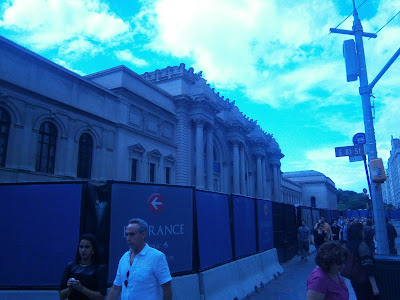


The front of the MET (Metropolitan Museum of Art) is undergoing renovations and all these construction walls and eye-sores had me thinking that the main entrance with the large stairs was closed. It turns out when I was exiting that the large stairway entrance is still available, its just that my initial view was blocked off from the annoying construction stuff. I had to enter the museum through a side entrance I never used before. The (recommended) adult donation fee was listed at twenty five bucks, but I just gave them a ten dollar bill. The cashier asked if I wanted any change back, but I let the museum keep the whole ten. The MET used to rely on different colored pins to be worn as proof of paying the entrance fee. A clever individual not interested in making a donation could ask for someone else's pin on the way out, or even better, have every color collected, and just slip on the right one after finding out what color the museum was using that day. Now the museum is no longer relying on the pin color system. Instead they're giving out stickers with the date printed on it to make it more difficult for those clever individuals who might try to sneak in without paying a donation (which literally could be a dollar). It was a weekday afternoon; a perfect time to come when there isn't the usual tourist overload as on weekends. The good part about entering the museum through this way was that I found myself in a section I don't recall ever visiting. I've been to the MET a countless number of times, but I don't remember ever seeing the Ancient Greece section I found myself in. It gave me an opportunity to catch up with Socrates and see a backside that was nearly five thousand years old.
After a little stroll I coincidentally became faced with the Civil War Art exhibit I came to see in the first place. It just popped in front of my face out of nowhere. They placed the section under a large tent, the type of large tents that served as mobile hospitals behind the battlefield to give patrons the an authentic Civil War experience. The only unfortunate part of the exhibit is that it is one of the few areas in which photos are not allowed to be taken. Of course a few tourists found their opportunities to play 'I no read English' and snap a few pictures, which drew the ire of security guards. From what I learned in school and what is generally accepted as common knowledge in American History is that Matthew Brady was mainly responsible for the photographs taken on the battlefields. After reading about the photos - I found out that's not entirely true. Yes, he did spend some time in the trenches with the North and snapped a few pictures when he was able to, but most of the shots came from photographers most people don't know about; Timothy H. O'Sullivan and Alexander Gardner to name a couple. The more cunning Brady was able to collect pictures from these other photographers and publish them in books under his name, taking most of the credit. Brady was initially allowed to accompany Northern troops at the Battle of Bull Run in which the Union foolishly thought the Confederates would be easily defeated by one quick skirmish. The South surprised the North with a victory at Bull Run which gave them the momentum in the war until Gettysburg turned the tide in 1863. The fighting was so fierce at Bull Run that Brady couldn't secure any pictures during the action (with also remembering in those days photography wasn't as simple as it is now). One infamous picture Brady can be rightfully credited for is one of Confederate General Robert E. Lee. The picture was snapped while Lee was in defeat, but he maintained this curiously pleasant look on his face that has brought the image so much notoriety. The photo session took place at Lee's home two days after Lincoln was assassinated. The Lee picture is generally referred to as the last of the Civil War photographs.
The expo contain more than just the photographs, there were actual campaign ribbons from when Lincoln was first running for president. When the war was underway, there were posters trying to get (Caucasian) citizens to enlist. The one I found most interesting was for Field Artillery. They were offering $150 on the spot if you signed up, and $452 if you previously served in the army for more than nine months and wanted to re-enlist. Being part of the Infantry and running up to the front lines with a musket almost guaranteed death, I think I would rather be back with the Field Artillery shooting off cannons, if I had the choice. All the volunteer posters made it clear that if you got drafted, then you would receive no bounty(money). The only way to make money from being a Union soldier is if you volunteered. Blacks did serve in the Union and Confederate armies, but their role was to act as servants for the white soldiers. The film "Glory" tells the true story of an all-Black Union regiment, but those situations were extremely rare. Doctors made use of the camera technology at the time. They would photograph wounded soldiers and show the proper method to amputate a limb or sew up a hole or cut. Then the photographs would be sent to other makeshift hospitals on the battlefields to serve as a guide for other doctors to follow. The pictures were quite graphic to my surprise. Both sides of the conflict couldn't imagine how bloody things would get and as a result there was a large shortage of surgeons and doctors available to treat wounded soldiers. These medical photographs certainly came in handy when manpower and knowledge was in short supply.
I didn't eat lunch before arriving, so by the time I was finished with the Civil War section I was rather hungry. I usually never use the museum cafeteria, but I didn't want to leave so soon - I wanted more for my ten dollar donation. For the first time ever I elected to try the cafeteria food. They have hot and cold food buffet style, and charge $14.10 per pound. The options were quite limited and I had thoughts of just going hungry for a few more hours, but I was doing alot of walking so some food would be necessary. I picked out what seemed to be cubes of quiche(I hope), rice with peas(didn't eat the peas), and a piece of flounder. These seemed to be the lightest items and my gamble paid off as the total came out to eleven dollars, which included a Snapple. Considering museum prices; this wasn't bad at all - except for the taste. With some energy back in my body from the "food", I picked up on my journey through the museum. My next stops included Dutch artistry such as Rembrandt and European such as Matisse. One funny moment occurred when a tourist went too close to a sculpture the alarm started sounding. Apparently the museum has installed detectors and make a noise when a person is getting too close to the piece. They're not big alarms for the whole museum to hear, but they make enough noise for the nearby security guard to come over and yell. If the person backs away, then the warning alarm shuts off. The Civil War expo wasn't the only special attraction at the MET, there was also Musical Instruments, the history of Punk (also no photo taking allowed), and something so basic yet so clever - Pictures from the 1920's to 1970's. I see those at flea markets and antique shops all the time. Collections of old pictures of regular people doing regular stuff. For this particular exhibit, someone went around to these venues and collected a massive amount of old pictures and put the most interesting ones on display.
By this time my legs were beginning to get tired and I wanted to get on the subway before the rush hour crowds took full effect. The only problem is I couldn't find my way out of the place. I kept going in circles and ended up at the same places over and over again. It did allow me to encounter some other sections I didn't see that day that I'm happy about; such as Native American and African art, but the only time I completely stopped searching for the exit is when I came upon the Modern Art area. The bright colors and vivid designs pulled me in to check out more of it. The piece I enjoyed the most was Andy Warhol's version of the Mona Lisa in his vintage multi-faced photographed on canvas form. Usually when I go to the MET I find time to visit the Egyptian area (best attraction) and pass by the Knights in Shinning Armor, but at this point I just wanted out of this maze. Through a few lucky guesses and turns I found myself in the Ancient Greek section again, which is where I came in, and I was finally able to find that exit. Such as most museums trips; I saw much but wish I had the time to see more. It was really a perfect day to go with the crowd light in numbers and certain rooms completely empty which allowed for personalized viewership. The Civil War expo is there till September 2nd and its well worth a donation under twenty five dollars. In no time I was out of the museum and back at the subway station to head home. Due to a fire on the tracks at E. 149th Street; my train had to make all local stops and naturally the air conditioner on the over-crowded subway car was broken on this muggy summer day.
And they thought they had it tough in the Civil War.....